
Compressed Air Installations in Madrid | Margal Ingenieros
Engineering, Design and Legalisation of Industrial Compressed Air Systems
Compressed air is a fundamental source of energy in modern industry. At MARGAL Ingenieros, We design and install complete compressed air systems optimised to maximise energy efficiency and minimise operating costs..
Our services include:
- Design of compressed air distribution networks.
- Compressor selection and sizing.
- Treatment systems: drying, filtering, condensation.
- Tanks and pressure accumulators.
- Energy recovery and consumption optimisation.
- Leak detection and elimination.
- Energy audits of existing installations.
We offer customised solutions for reliable and efficient compressed air supply quality, significantly reducing energy costs.
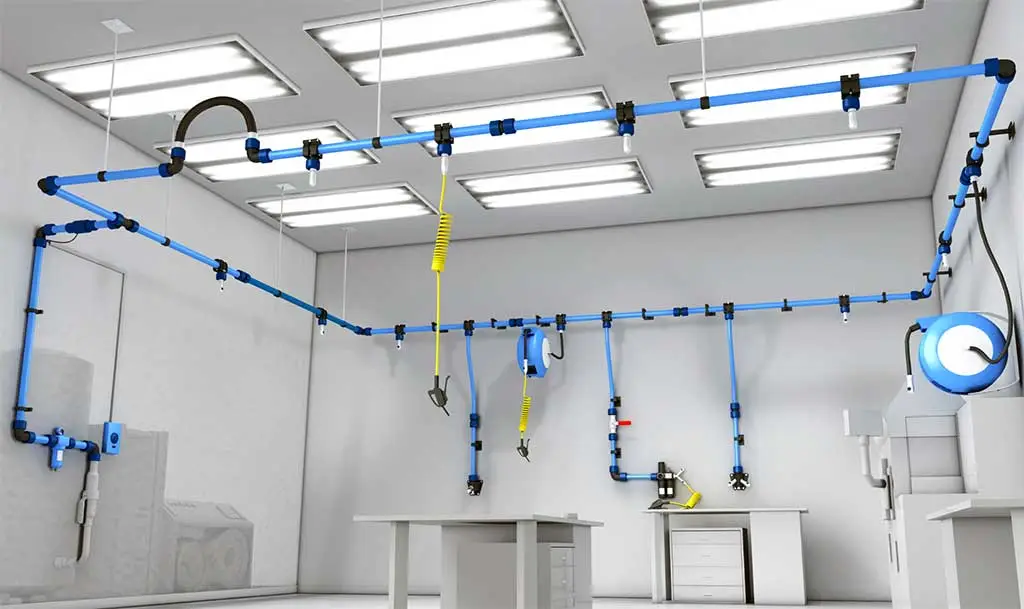
We design, calculate, legalise and execute compressed air projects for all types of industrial sectors.
What is included in a compressed air installation project?
An efficient installation is not just about placing a compressor. It requires a comprehensive design based on real calculations of consumption, simultaneity, flow rates and pressure drops.
Our projects include:
- Study of real consumption needs (Nm³/h and working pressure).
- Pipe network calculation and optimal sizing.
- Compressor selection (fixed or variable speed).
- Drying and air treatment systems (refrigeration or absorption dryers).
- Filters, drains and condensate removal.
- Accumulator tanks.
- Control and monitoring systems.
- Closed ring design to minimise pressure drop.
- Energy optimisation and leakage reduction.
- Legalisation in accordance with current regulations.
Compressed Air Network Design: Efficiency from the Source.
A badly dimensioned network can generate:
- Pressure drops greater than 0.5 bar.
- Unnecessary electricity consumption.
- Premature wear and tear of equipment.
- Increased energy costs of up to 30%.
That is why we do:
Technical calculation of the network
- Recommended velocity in main and secondary pipelines.
- Cumulative pressure losses.
- Optimised diameters.
- Study of future enlargements.
Selection of suitable materials
- Modular aluminium.
- Galvanised steel.
- Stainless steel.
- Industrial technical polyethylene.
Compressed Air Installations for Industry
We work for multiple sectors:
Food industry
In the food industry, compressed air systems are vital because of their versatility, being used both as a source of energy (power air) and as a direct part of the production process (active air).
In this sector, the most common applications are air cutting, filling, handling, packaging and fluid pumps.
Industrial workshops
In industrial workshops, compressed air is the "fourth basic utility" alongside electricity, water and gas. It is mainly used for power and precision work with greater safety than power tools.
In these environments, it is vital to use maintenance units (FRL: Filter, Regulator and Lubricator) to prevent oxidation from moisture in the air.
Pharmaceutical sector
Sterility is the top priority in the production of pharmaceuticals, which means that the compressed air used in the movement and packaging of products must be of the highest quality.
To comply with these strict health controls, companies opt for oil-free technology. This is a logical choice for sensitive sectors.
Logistics centres
In modern logistics centres, compressed air is the engine of intralogistics, allowing thousands of packages to be moved and sorted with a speed that would be impossible by hand.
Because these centres operate 24/7, system reliability is critical; a drop in air pressure can bring the entire supply chain to a halt, costing thousands of euros for every hour of downtime.
Automotive
Whether we are talking about massive factories or small neighbourhood workshops, compressed air is the essential fuel of the automotive industry.
Whether in large-scale robotic processes or local maintenance tasks, the dependence on compressed air is total. Ensuring constant power is critical in this sector.
Production plants
Compressed air is, for all practical purposes, the fourth basic supply in any factory, along with electricity, water and gas. Given its importance, the priority is to maximise operational efficiency through audits.
The aim is to tackle air leakage, a common problem that can increase electricity bills by up to 30% according to IDAE estimates, directly affecting company profit margins.
Each sector requires specific levels of air quality (ISO 8573-1), especially in critical processes.
Energy Optimisation in Compressed Air Systems
Compressed air can account for between 10% and 25% of an industrial plant's electricity consumption.
We apply solutions such as:
- Variable speed compressors.
- Heat recovery.
- Master-slave control systems.
- Leak detection and correction.
- Real-time monitoring.
- Specific energy audits.
- We reduce energy costs and improve the sustainability of your installation...
Legalisation of Compressed Air Installations
We manage the entire legalisation process in accordance with:
- Pressure Equipment Regulation (REP).
- ITC EP corresponding to them.
- Registration of industrial installations.
- Certifications and pressure tests.
- Legalisation in accordance with current regulations.
We take care of technical documentation, certificates and commissioning.
Maintenance and Expansion of Compressed Air Networks
In addition to the initial design, we offer:
- Review of existing installations.
- Leakage audits.
- Network extensions.
- Replacement of obsolete compressors.
- Improvement of the air treatment system.
- Energy efficiency studies.
An optimised network reduces breakdowns and increases the lifetime of equipment.

Why trust Margal Ingenieros?
✔ Design based on actual calculations, not estimates.
✔ Certifiable energy optimisation.
✔ Guaranteed regulatory compliance.
✔ Turnkey projects.
✔ Experience in demanding industrial environments.
We work with leading manufacturers and tailor-made solutions.
Request a Compressed Air Installation Project
If you need:
- Design a new installation.
- Optimise your existing network.
- Reduce energy costs.
- Legalise your system.
- Expand your productive capacity.
- We are ready to help you.
FAQS
Frequently Asked Questions about Compressed Air Installations.
Engineering note: «Compressed air is not free; in fact, it is the most expensive energy in a factory. Smart design is not an expense, it's an investment with a very quick return on investment (ROI)».»
It is determined according to the total required flow rate (Nm³/h), working pressure, simultaneity of use and possible future extensions.
It depends on the process, but typically between 6 and 8 bar. Designing for higher pressures increases energy consumption.
Between 15% and 30% in electricity consumption if the installation is leaking or oversized.
Screw: Ideal for constant and high demands (24/7). They are more efficient, quieter and more durable.
Piston: Recommended for intermittent demands or small workshops where airflow is not continuous.
When your plant's air demand fluctuates throughout the day. A compressor VSD adjusts motor speed to actual demand, avoiding unnecessary load/unload cycles and saving energy significantly compared to fixed speed models.
Quality is governed by the standard ISO 8573-1. Depending on the application, you will need different degrees of filtering and drying:
| Sector | Main Requirement | Recommended Compressor Type |
| Pharmacy/Food | Sterile and oil-free air | Oil-free (Class 0) |
| Automotive (Painting) | Absence of particles and silicones | Lubricated with high efficiency filtration |
| Heavy Industry | Power and reliability | Standard lubricated |
In Spain, installations must comply with the Pressure Equipment Regulation (REP). This includes registration of the installation with Industry, mandatory periodic tank inspections and documented preventive maintenance.
Compressed air generates water. If not treated with proper dryers and blowdowns, this moisture will rust pipes, damage pneumatic tools and contaminate the final product. In addition, oily condensate must be treated before it is discharged to the sewer to comply with environmental regulations.
It depends on the hours of operation, but the standard is minor overhaul every 2,000 - 3,000 hours and major overhaul every 8,000 hours. Ignoring these deadlines often results in much more costly breakdowns and unplanned production stoppages.
Absolutely. Compressed air is one of the most expensive utilities to produce. An audit detects leaks, pressure drops and inefficient points of use. According to the IDAE, tackling leaks can reduce plant electricity consumption by up to 30%..
CONTACT
Request your personalised technical study.
If you need to design, optimise or legalise an industrial compressed air installation in Madrid, our technical team is ready to help you.
 Español
  English (UK)
  Deutsch